
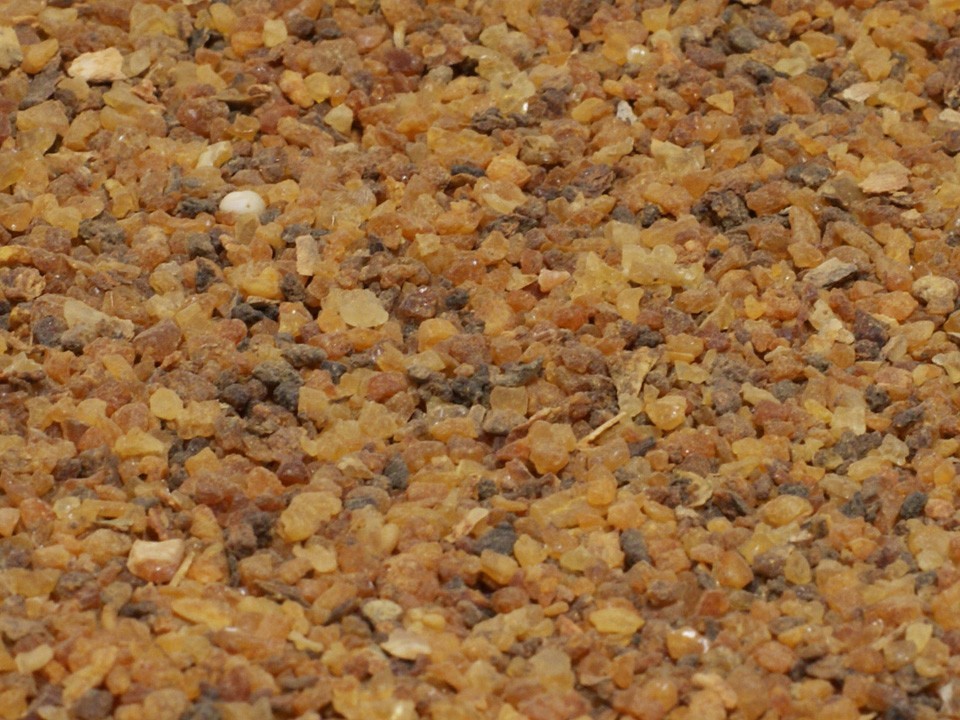
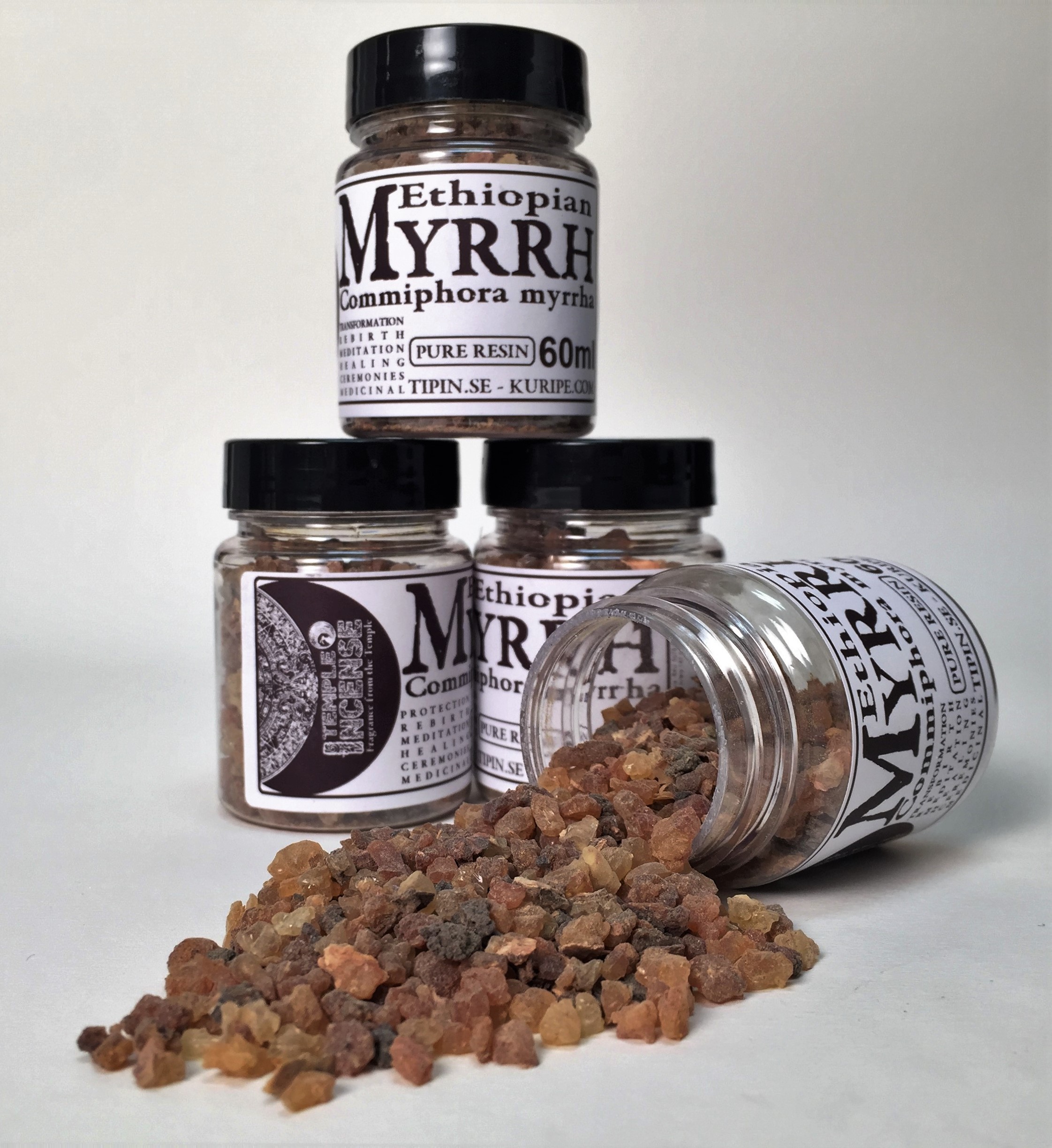
Myrrh (Commiphora myrrha)
Myrrh is together with gold and Frankincense the gifts that the three wise men brought to the newborn Christ. It has been celebrated by many cultures through millennia for its use as incense and herbal remedies. The resin is extracted from several small and thorny trees in the Commiphora genus that grow naturally in Somalia and Ethiopia. The trees belong to the family burseraceae (sometimes referred to as the Copal family), which also Palo Santo, Copal and Frankincense belongs to. Myrrh means bitter in Arabic, which refers to its fragrance upon combustion. The scent is medium heavy, slightly sweet, quite bitter and earthy. The smell is soothing and relaxing. Myrrh corresponds to Saturn and the Kabbalistic sphere Binah according to Liber 777, which makes it suitable for the work of exploring the unknown, bringing structure, focus on the earth and water element, as well as death processes and rebirth. Myrrh is also often used to clean a space and raise the consciousness. It is common for myrrh to be mixed with other incense resins like Frankincense.
WEIGHT/VOLUME
Price

60ml POT
€5.90

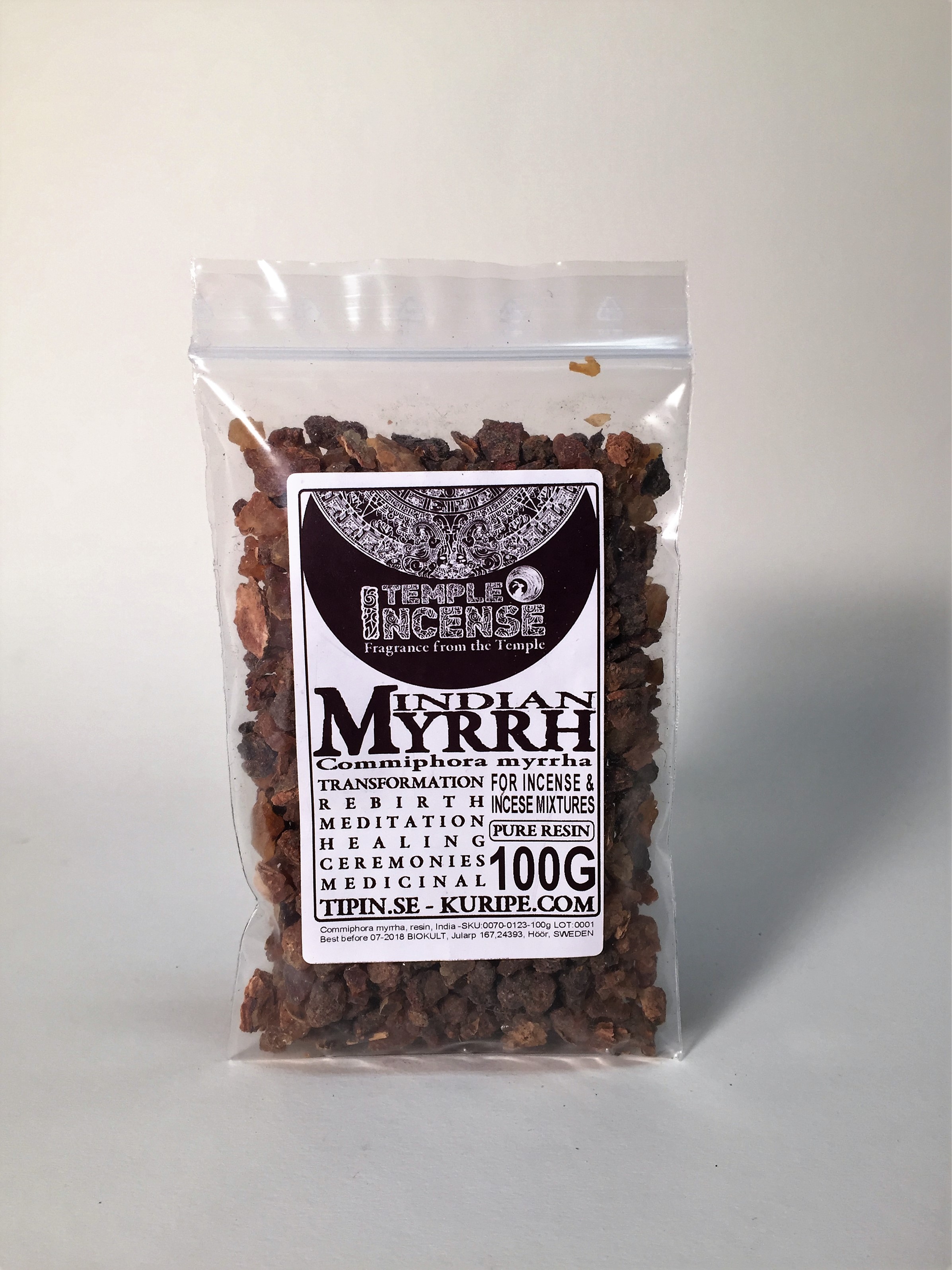
100g BAG
€13.60

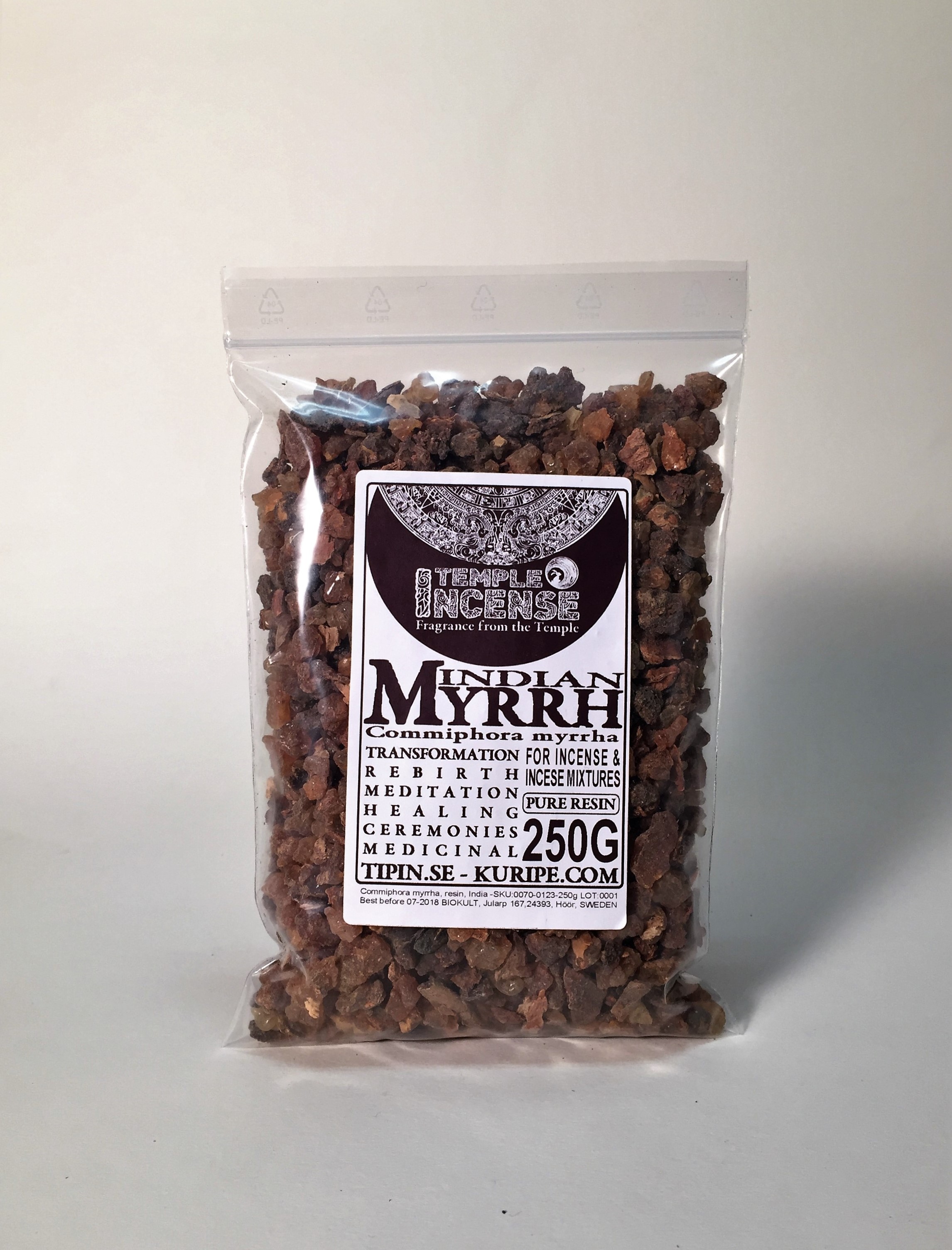
250g BAG
€33.30

1000g BAG
€111.20
- Secure payment by card
- E-mail us, we reply swiftly!
- Ships in 1-3 business days
- Fast and secure global shipping
Some aromatic plants and products may have a historical use of folkloric nature, but we offer this product as incense and/or botanical curiosa; neither food grade, for consumption nor medical use, unless other is stated. This means that you should contact your doctor even though, for example, frankincense have been used during the Middle Ages as a remedy for bubonic plague. Avoid contact with skin and eyes. Keep away from children and animals. The snuffs containing tobacco should be used moderately and not daily since tobacco is addictive. The long-term use of tobacco snuff is unknown and should therefore be used with this in mind.
Description
Article no.: MY
Summary
Common Name: Myrrh
Scientific name: Commiphora myrrha
Part of the plant: Resin
Origin: Kenya
Scent: Medium heavy, slighly sweet, rather bitter and earthy
Usage: Solitary or in incense mixes, medical & health promotion, perfumery
Magical use: Ceremonial incense, ointment ingredient
Magical properties: Grounding, cleansing, healing, calming, earth and water element, Saturn/Binah (3), that which is outside ones concept of reality, death processes and rebirth, helps moving forward emotionally
Background
Myrrh is together with gold and Frankincense the gifts the three wise men brought to baby Jesus. It has been celebrated by many cultures through millennia for its use as incense, and herbal and perfumery ingredient. In ancient times, Myrrh was used as a preservative in wine and by the Egyptians for the embalming of the dead. As herbal medicine, myrrh was used by Greek and Roman doctors, as well as in Chinese medicine and Ayurveda.
The resin is extracted from several small and thorny trees in the Commiphora genus that grow naturally in Somalia and Ethiopia. The trees belong to the family burseraceae (sometimes referred to as the Copal family), which also Palo Santo, Copal and Frankincense belongs to.
Myrrh was an important commodity of antiquity and was considered worth more than its weight in gold. During the Roman Empire, Myrrh was worth about five times more than Frankincense, although the latter was considerably more popular. The name myrrh comes from the word "Mur", which in Hebrew and Arabic means bitter. The family name Commiphora comes from the Greek "Kommi" and "Phoros", meaning gum and bearer.
Other names
Balsamodendron Myrrha. Commiphora Myrrha, var. Aceite de palo, African Myrrh, Bal, Balasmodendron, Balsam copaiba, Bdellium, Bol, Bola, Bowl, Burseraceae, B samo de copayba, Cobeni, Commiphora Molmol, Commiphora Myrrha, Copaiba, Copaipera, Cupayba, Copauba, Copal, Copaiva, Copaiba-verdadeira, Copaibeura-de-Minas, Didin, Didthin, Guggal Resin, Gum Myrrh, Heerabol, Jesuit's balsam, Matidisguate, Matisihuati, Mal-dos-sete-dias, Mirra, Molmol, Morr, Mo Yao, Myrrh, Opopanax, Pau-de-oleo, Somali Myrrh.
Fragrance
Myrrh is medium heavy, slightly sweet, quite bitter and earthy. When burned, the smell is soothing and calming. Myrrh creates a magical & ceremonial context, perfect for rituals and meditation.
Use & Magical Properties
Myrrh is an excellent solitary incense but is often used in mixtures with eg. Frankincense or other resins. It has several medicinal and health-promoting properties as well as a common fragrant ingredient in cosmetics and skin & hair products.
When myrrh is burned, the resin gets a bit charred after a while and smells burned. Instead of placing the resin directly on the coal, you can put a piece of aluminum foil between the charcoal disc and the resin.
One of the myrrh's properties is to open up the emotional body where dilapidated emotions can be released so that they no longer are like plugs in the subconscious, which takes energy and prevents the consciousness from moving freely. This corresponds according to Liber 777 with Binah's (3) passive side linked to sorrow and bitterness. In this case, bitterness is an effect of the blocked of emotions, where grief is the death process that causes the blockages to be torn down and the operator is released and reborn. Myrrh also corresponds to Liber 777 with path 23 (Mem - the hanged man) and the water element.
Legal disclaimer
Some aromatic plants and products may have a historical use of folkloric nature, but we offer this product as incense and/or botanical curiosa. Neither food grade, for consumption nor medical use. Avoid contact with skin and eyes. Keep away from children and animals.
Common Name: Myrrh
Scientific name: Commiphora myrrha
Part of the plant: Resin
Origin: Kenya
Scent: Medium heavy, slighly sweet, rather bitter and earthy
Usage: Solitary or in incense mixes, medical & health promotion, perfumery
Magical use: Ceremonial incense, ointment ingredient
Magical properties: Grounding, cleansing, healing, calming, earth and water element, Saturn/Binah (3), that which is outside ones concept of reality, death processes and rebirth, helps moving forward emotionally
Background
Myrrh is together with gold and Frankincense the gifts the three wise men brought to baby Jesus. It has been celebrated by many cultures through millennia for its use as incense, and herbal and perfumery ingredient. In ancient times, Myrrh was used as a preservative in wine and by the Egyptians for the embalming of the dead. As herbal medicine, myrrh was used by Greek and Roman doctors, as well as in Chinese medicine and Ayurveda.
The resin is extracted from several small and thorny trees in the Commiphora genus that grow naturally in Somalia and Ethiopia. The trees belong to the family burseraceae (sometimes referred to as the Copal family), which also Palo Santo, Copal and Frankincense belongs to.
Myrrh was an important commodity of antiquity and was considered worth more than its weight in gold. During the Roman Empire, Myrrh was worth about five times more than Frankincense, although the latter was considerably more popular. The name myrrh comes from the word "Mur", which in Hebrew and Arabic means bitter. The family name Commiphora comes from the Greek "Kommi" and "Phoros", meaning gum and bearer.
Other names
Balsamodendron Myrrha. Commiphora Myrrha, var. Aceite de palo, African Myrrh, Bal, Balasmodendron, Balsam copaiba, Bdellium, Bol, Bola, Bowl, Burseraceae, B samo de copayba, Cobeni, Commiphora Molmol, Commiphora Myrrha, Copaiba, Copaipera, Cupayba, Copauba, Copal, Copaiva, Copaiba-verdadeira, Copaibeura-de-Minas, Didin, Didthin, Guggal Resin, Gum Myrrh, Heerabol, Jesuit's balsam, Matidisguate, Matisihuati, Mal-dos-sete-dias, Mirra, Molmol, Morr, Mo Yao, Myrrh, Opopanax, Pau-de-oleo, Somali Myrrh.
Fragrance
Myrrh is medium heavy, slightly sweet, quite bitter and earthy. When burned, the smell is soothing and calming. Myrrh creates a magical & ceremonial context, perfect for rituals and meditation.
Use & Magical Properties
Myrrh is an excellent solitary incense but is often used in mixtures with eg. Frankincense or other resins. It has several medicinal and health-promoting properties as well as a common fragrant ingredient in cosmetics and skin & hair products.
When myrrh is burned, the resin gets a bit charred after a while and smells burned. Instead of placing the resin directly on the coal, you can put a piece of aluminum foil between the charcoal disc and the resin.
One of the myrrh's properties is to open up the emotional body where dilapidated emotions can be released so that they no longer are like plugs in the subconscious, which takes energy and prevents the consciousness from moving freely. This corresponds according to Liber 777 with Binah's (3) passive side linked to sorrow and bitterness. In this case, bitterness is an effect of the blocked of emotions, where grief is the death process that causes the blockages to be torn down and the operator is released and reborn. Myrrh also corresponds to Liber 777 with path 23 (Mem - the hanged man) and the water element.
Legal disclaimer
Some aromatic plants and products may have a historical use of folkloric nature, but we offer this product as incense and/or botanical curiosa. Neither food grade, for consumption nor medical use. Avoid contact with skin and eyes. Keep away from children and animals.