
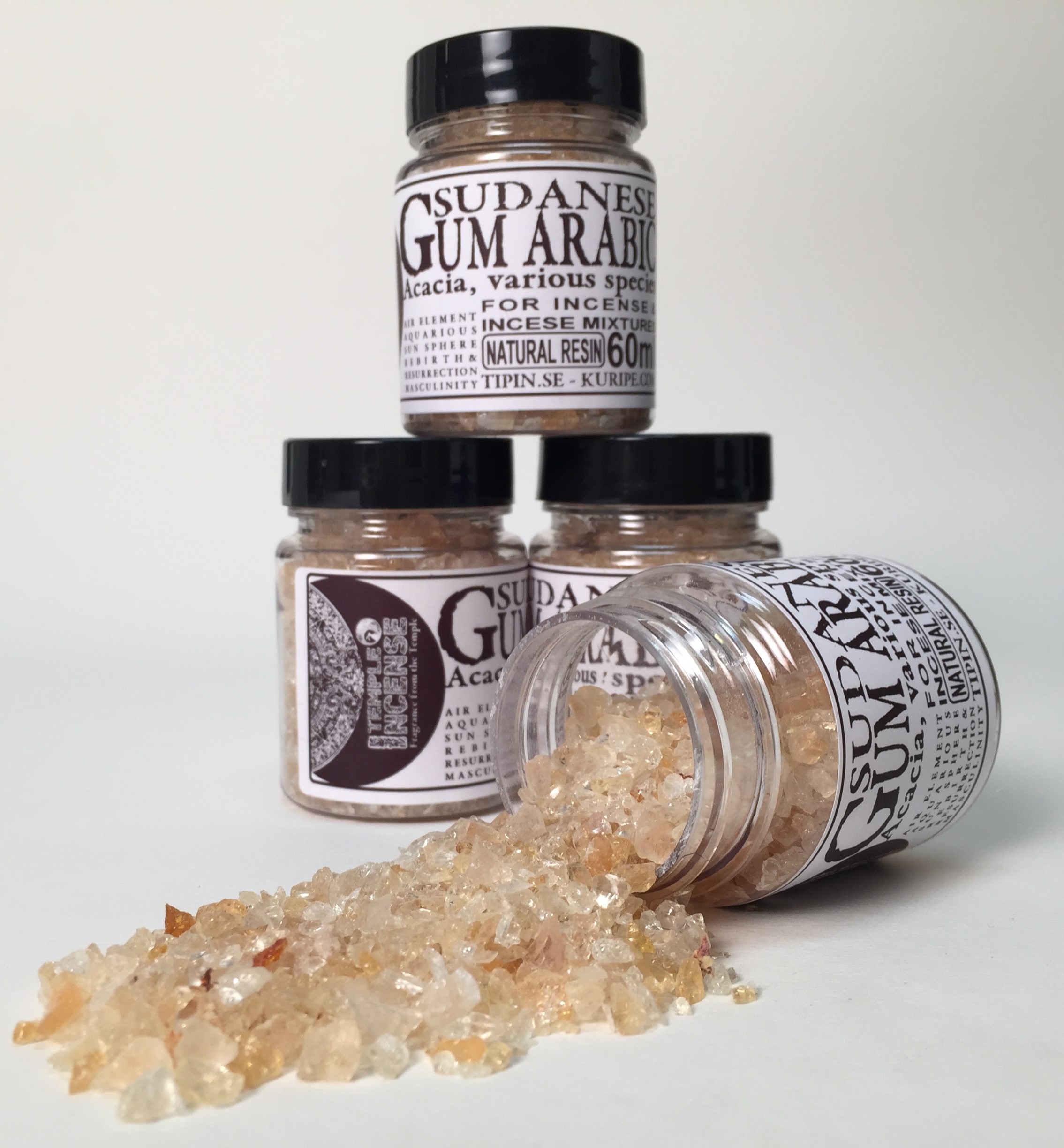
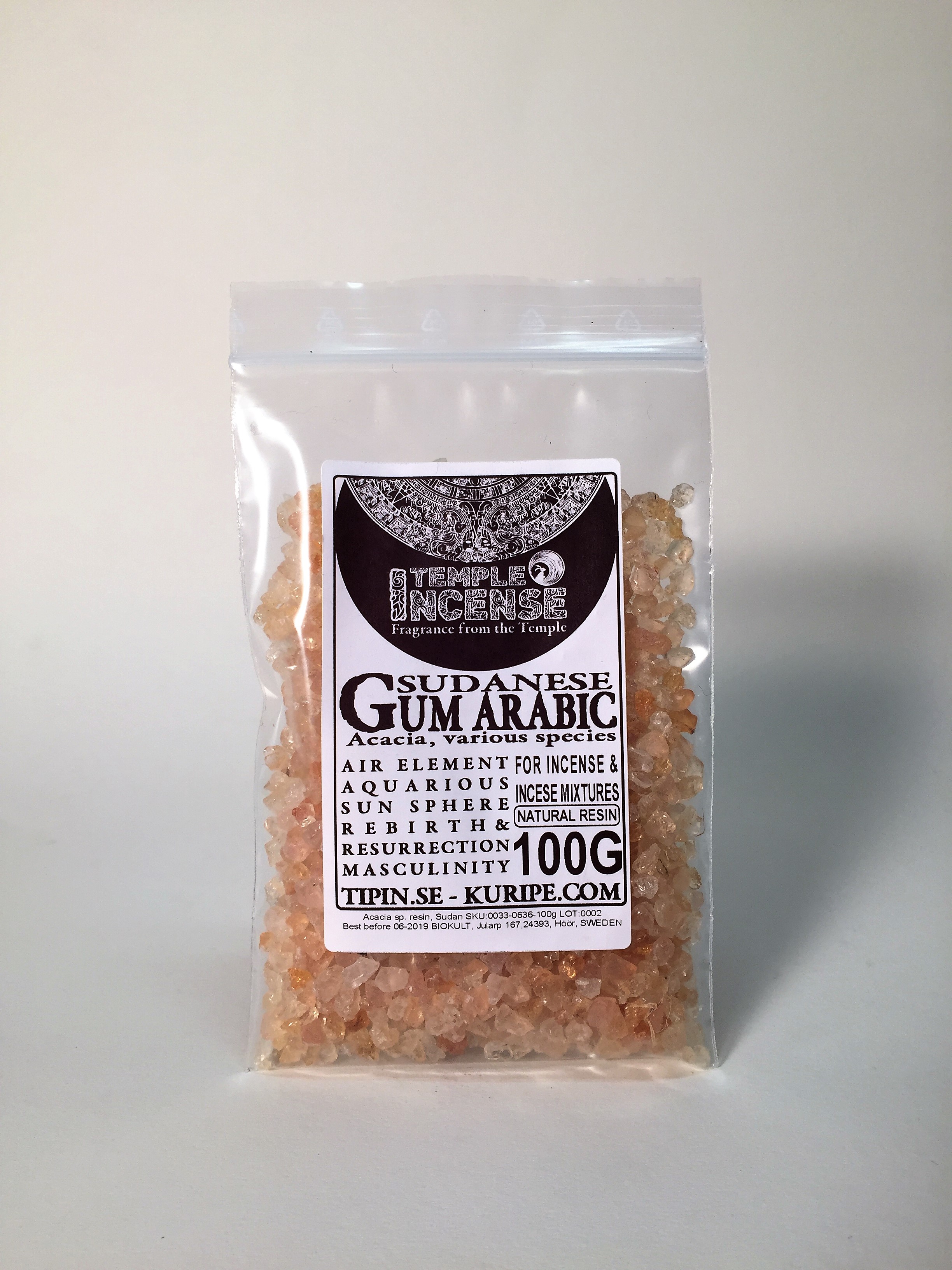
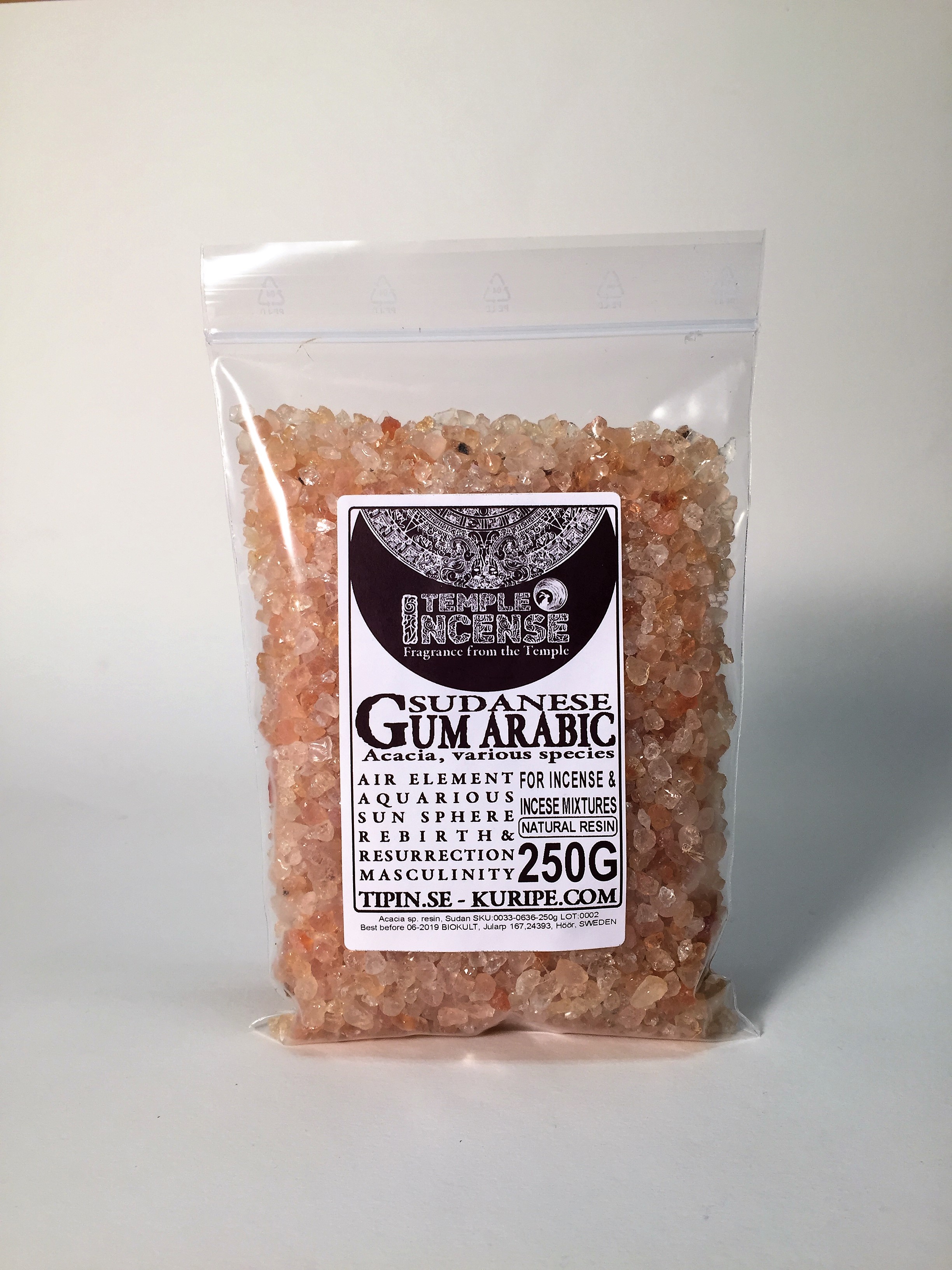
Gum Arabic (Acacia sp.)


- Secure payment by card
- E-mail us, we reply swiftly!
- Ships in 1-3 business days
- Fast and secure global shipping
Some aromatic plants and products may have a historical use of folkloric nature, but we offer this product as incense and/or botanical curiosa; neither food grade, for consumption nor medical use, unless other is stated. This means that you should contact your doctor even though, for example, frankincense have been used during the Middle Ages as a remedy for bubonic plague. Avoid contact with skin and eyes. Keep away from children and animals. The snuffs containing tobacco should be used moderately and not daily since tobacco is addictive. The long-term use of tobacco snuff is unknown and should therefore be used with this in mind.
Description
Article no.: GA
Common Name: Gum Arabic / Acacia gum
Scientific name: Acacia sp.
Part of the plant: Resin
Origin: Sudan
Scent: Mild scent, sweet and slightly fruity with touches of nuts
Usage: Solitary or in incense mixtures, binder for production of own incense, is also used as food additives as well as a water-soluble paper glue
Magical use & properties: Ceremonial combustion, get in touch with one's greater being and the higher consciousness (solar sphere), transformation and resurrection
Background
Gum Arabic, also known as Acacia gum, comes from the sap of different African acacia trees. About 80% of all commercially harvested Gum Arabic comes from wild acacia trees in Sudan. The sap is dried which becomes crystallized to a resin.
Gum Arabic has a wide range of uses. The resin is water-soluble, which makes it used as a paper glue. For example, it's Gum Arabic that is used as the glue of cigarette roll paper. Because Gum Arabic is almost completely without flavor and smell, it is widely used in food and candy, often to change consistency or as a binding agent. Its E-number is E414.
Fragrance
Gum Arabic from this Sudanese Acacia sp. has a gentle scent that is sweet and slightly fruity with a touch of nuts. However, in comparison to many other resins it has a very mild odor.
Usage & magical properties
Gum Arabic is known for many as a binding-agent and food additive, but few know that it is an excellent incense. Although it has a very mild scent, it is absolutely noticeable and characteristic. It works very well solitarely but acts as an amplifier with other incenses. Since it is water-soluble, it is a traditional ingredient in incense mixtures. The resin is then crushed to a powder and mixed with a small amount of warm water (until the resin is completely dissolved). To the batter, add other fragrant ingredients such as resins, herbs, spices, dried fruits, etc. Preferably with ingredients that have corresponding properties desired in the incense mixture, made with specific intention. The batter, with other ingredients is then smeared out in a thin layer that is allowed to air dry until it is crisp enough to crush. The crushed mixture should then be like a resin and used in the same way for example on charcoal discs. Another excellent recipe is to mix Gum Arabic (dissolved in water to a slurry like above) with powdered chips from Palo Santo as well as any other crushed resin, eg. Copal. The thick dough can then with your hands or a mold be formed into sticks that after drying fora couple of days, can be used just like Palo Santo sticks, but with a clear scent of the chosen resin. An easy way to burn resins without charcoal discs.
Just the acacia tree like Rubber Arabicum comes from where the tree that a sprigy branch was used to make the crown of thorns placed on Christ's head during the crucifixion. The tree and resin are therefore traditionally linked to the resurrection mysteries and the sun sphere.
Gum Arabic is the resin of the same tree (Acacia tree) as the thorn crown placed on the head of Christ during the crucifixion and is therefore often linked to the mysteries of resurrection and the solar sphere.
Legal disclaimer
Some aromatic plants and products may have a historical use of folkloric nature, but we offer this product as incense and/or botanical curiosa. Neither food grade, for consumption nor medical use. Avoid contact with skin and eyes. Keep away from children and animals.