
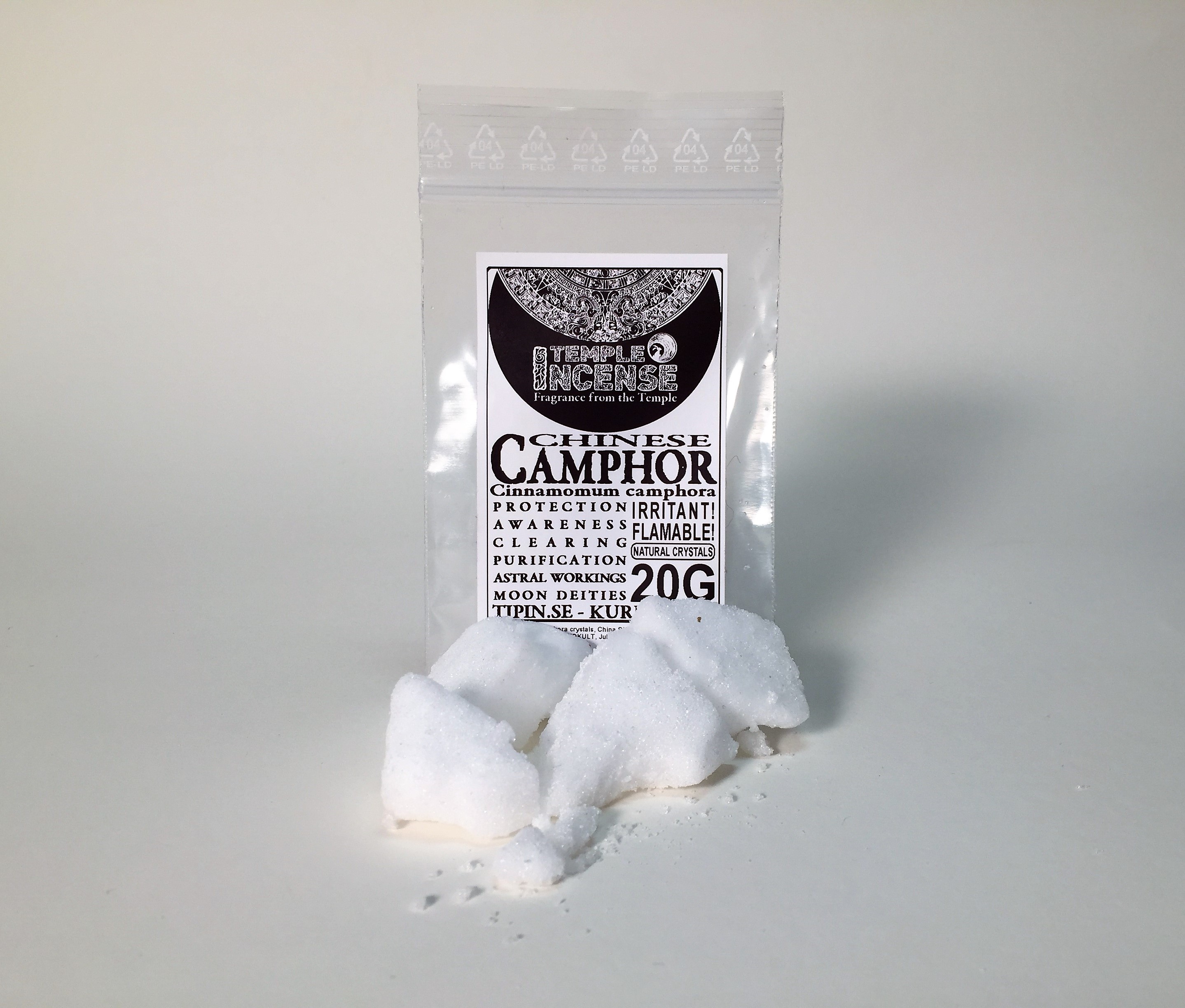
Camphor (Cinnamomum camphora)

- Secure payment by card
- E-mail us, we reply swiftly!
- Ships in 1-3 business days
- Fast and secure global shipping
Some aromatic plants and products may have a historical use of folkloric nature, but we offer this product as incense and/or botanical curiosa; neither food grade, for consumption nor medical use, unless other is stated. This means that you should contact your doctor even though, for example, frankincense have been used during the Middle Ages as a remedy for bubonic plague. Avoid contact with skin and eyes. Keep away from children and animals. The snuffs containing tobacco should be used moderately and not daily since tobacco is addictive. The long-term use of tobacco snuff is unknown and should therefore be used with this in mind.
Description
Article no.: CA20
Common name: Camphor
Scientific name: Cinnamomum camphora
Part of the plant: resin / crystallized sap
Origin: China
Scent: Strong and fresh scent resembling mint / menthol
Usage: Solitary or in incense mixtures; medical & health promotion; mosquito, moth and insect repellant
Magical usage & properties: Ceremonial combustion, for focus on dreams and astral workings, the moon sphere and lunar deities; for protection, awareness, cleansing and clarity
Warning: Flammable and irritating to skin and mucous membranes, toxic when consumed in larger quantities
Background
Camphor is the white crystalline substance obtained from the tree Cinnamomum camphora, originating from China, Japan and surrounding parts of eastern Asia. The tree belongs to the Laurel family, Lauraceae.
White Camphor crystals are found in some older trees while other trees only produce oil, which can be oxidized to crystals. Even the branches, roots and wood chips of the tree are steam distilled to produce Camphor crystals and Camphor oil. The sturdy tree has shiny and waxy, dark green aromatic leaves. When it is mature, the tree can reach a height of 20-30 meters. The tree rejects insects, moths, flies and is very durable against erosion of salt air. The wood must be at least 50 years to produce oil.
The oil extracted from the tree is highly valued by Chinese people for the manufacture of medicinal preparations, and the penetrating strong smell is a well-known prevention against moth, mosquitoes and other harmful insects like woodworm. In fact, natural history storage cabinets for entomologists are often made of wood from this tree. Older Camphor, which is less volatile than newly harvested, is used in Chinese funeral rites and embalming.
Camphor contains alpha-pinene, camphene, beta-pinene, sabins, phellandene, limonene, 1,8-cineole, y-turpentine, p-cymene, terpinolene, furfural, camphor, linalool, bornyl acetate, terpin-4-ol , Caryophyllene, borneo, piperitone, geraniol, safrole, cinnamaldehyde, methyl cinnamate and eugenol.
Other names
Kamfer, Camphor, Laurel Camphor, Camphor Laurel, Gum Camphor, True Camphor, Hon-Sho, Japanese Camphor, Formosa Camphor.
Fragrance
Camphor has a strong and fresh scent resembling mint / mentol.
The scent of Camphor is said to increase the Prana flow, open up the senses and clarify them, relieve headaches and raise awareness. Powerful, penetrating and medical are three words to describe Camphor's unique fragrance, which blends well with:
Rosemary (Rosmarinus officinalis), Basil (Ocimum basilicum), Cajeput (Melaleuca quinquenervia), Chamomile (Matricaria chamomilla), Lavender (Lavandula angustifolia), Eucalyptus (Eucalyptus obliqua), Frankincense (Boswelia carteri), Juniper, Melissa, Wintergreen.
Usage & magical properties
Camphor has a wide range of applications. It has, and is still used in the Mahashivatri celebration of God Shiva, in India. It burns cool without leaving any ash residues. Camphor can be ignited or placed on a lit charcoal disc. In the 19th century, there was a great demand for the use of celluloid, an edible form of Camphor, currently used in flavoring sweets and desserts in Asia. Other modern uses include moth-repellents and other anti-insect products, embalming and fireworks. Camphor is a well-established folk medicine but is toxic if taken in large amounts.
Camphor is perfect for ceremonial combustion for the focus on dreams and astral workings, the moon sphere and lunar deities, for protection, awareness, cleansing and clarity.
Warning
Camphor is flammable and irritating to skin and mucous membranes, as well as toxic when consumed in larger amounts.
Legal disclaimer
Some aromatic plants and products may have a historical use of folkloric nature, but we offer this product as incense and/or botanical curiosa. Neither food grade, for consumption nor medical use. Avoid contact with skin and eyes. Keep away from children and animals.